
ConstructVue Academy · Lesson 10
Construction software best practices: standards, accountability and discipline
What separates a system that holds from one that drifts — standardization, clear accountability, operational discipline, and a way to keep the team learning as the platform grows.
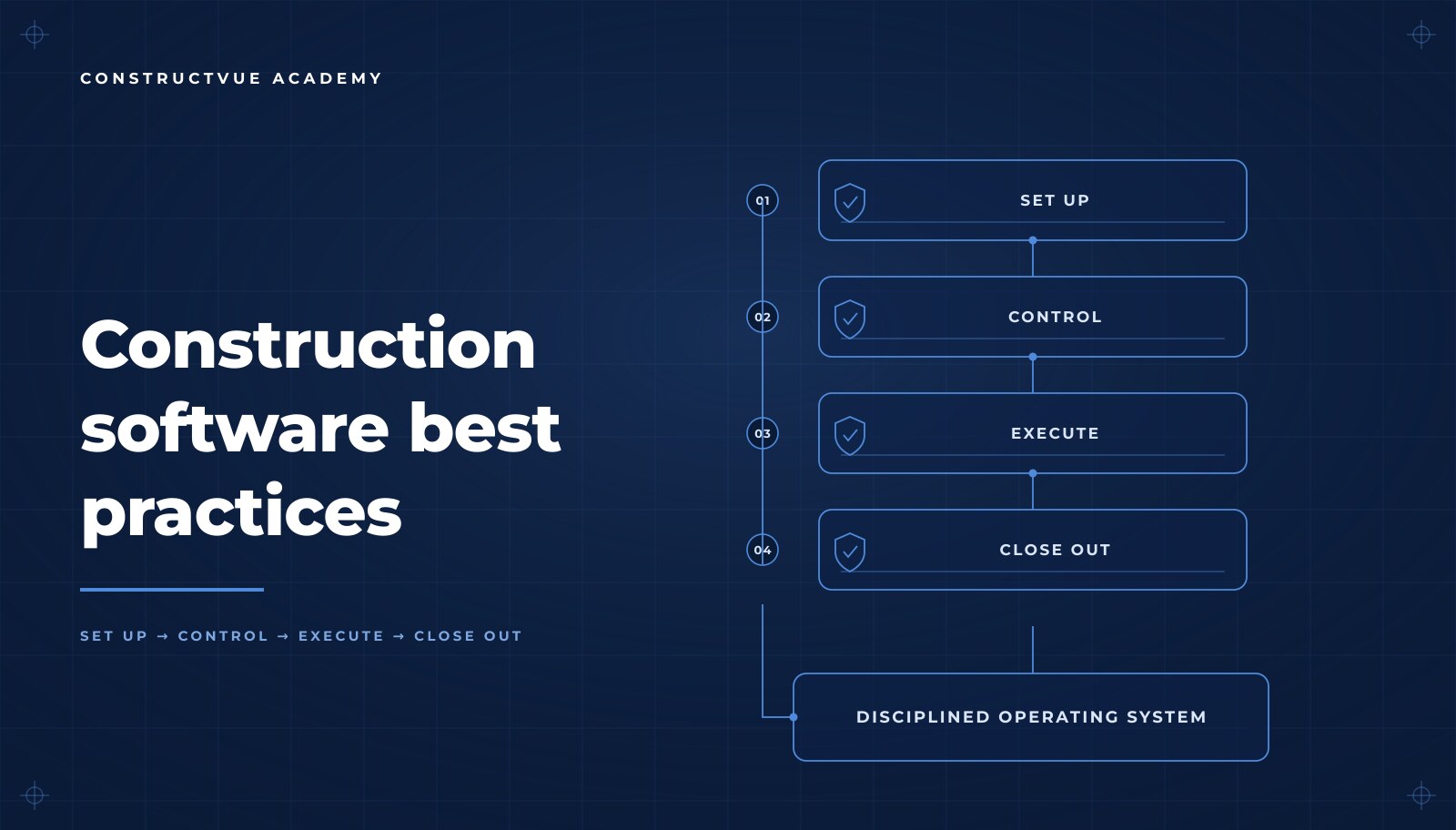
Two companies can run the same platform and get completely different results. The difference is almost never the software. It is whether the company standardized its structure, named owners for its records, and kept a cadence when the job got busy.
This lesson closes the series with the operating habits that decide whether a system holds together in year two — the point at which the original champion has moved on and the record is either self-sustaining or already drifting.
Learning objectives
- Standardize naming, work breakdown and budget structure at the organization level.
- Assign a named owner to each record type instead of relying on shared responsibility.
- Use the audit trail as the accountability mechanism rather than supervision.
- Record events when they happen, not at month end.
- Resolve findings rather than acknowledge them.
- Keep the team learning through the Academy as the platform grows.
Standardization
Standardization is not bureaucracy; it is what makes records comparable and therefore readable. Naming and numbering, the work breakdown, and the budget structure are inherited by everything downstream, so setting them once at the organization level is the cheapest quality decision available.
Templates over instructions
A written convention describes the right answer. A template produces it. Where the platform can carry the standard — project templates, role definitions, workflow defaults — put it there rather than in a document nobody opens twice.
Accountability
Every record type needs an owner: someone accountable for commitments, someone for compliance, someone for the daily log. Work that belongs to everyone is done by no one on the week it matters.
Accountability is enforced by visibility, not by supervision. Every change is attributable and every finding names the record behind it, so a review can ask what happened rather than who to believe. Access should follow the least-privilege model in the roles and permissions lesson.
Operational discipline
- Record events when they happen — a daily log written on Friday is fiction with good intentions.
- Resolve findings rather than acknowledging them; an acknowledged risk is still a risk.
- Keep subcontractor compliance current before mobilization, never after.
- Let awards create commitments, contracts and budget movement from one event rather than by re-keying.
- Never manage from an export — the moment a spreadsheet becomes the working copy, the record becomes documentation.
Continuing your journey
Make the Academy part of onboarding. New hires work the lessons in order; existing staff revisit whichever lesson matches the change the company is about to make. The full series runs from first login through procurement, project controls, reporting and portfolio management.
Frequently asked questions
What makes construction software adoption stick?
Standardization, ownership and cadence. Standard structure so records are comparable, a named owner for every record type so nothing is everyone's job, and a fixed rhythm for entry and review so the record stays current without heroics. Software rarely fails on features; it fails when nobody owns the habit.
Where should standardization start?
With naming and numbering, the work breakdown, and the budget structure — the three things every downstream record inherits. Standardizing them once at the organization level is worth more than any amount of later cleanup, because every project created afterwards is born correct.
How do you create accountability without micromanaging?
Give each record type an owner and make the audit trail visible. When it is clear who owns commitments, who owns compliance and who owns the daily log — and when every change is attributable — accountability comes from visibility rather than supervision.
What does operational discipline look like day to day?
Record events when they happen rather than at month end, resolve findings instead of acknowledging them, keep compliance current before mobilization, and never manage from an export. None of it is difficult; all of it is easy to defer, which is exactly why it needs a cadence.
How should a team keep learning after rollout?
Treat the Academy as part of onboarding rather than as a launch event. New hires work the lessons in order; existing staff revisit the lesson that matches whatever the company is about to change. A platform grows, and a team that stops learning ends up using last year's version of it.
Related Academy lessons
For how these habits are supported by the system itself, see how the ConstructVue platform connects each workflow, or return to the Academy hub for the full series.
Lesson chapters
- 0:04Welcome
- 0:22Standardization
- 0:54Accountability
- 1:23Operational discipline
- 1:47Continuing your journey