
ConstructVue Academy · Lesson 3
How to set up a new construction project: naming, templates, team and budget
How to create a construction project record that the next eighteen months can rely on — naming and numbering, templates, delivery method, the project team, and a budget baseline that becomes the reference point for every commitment.
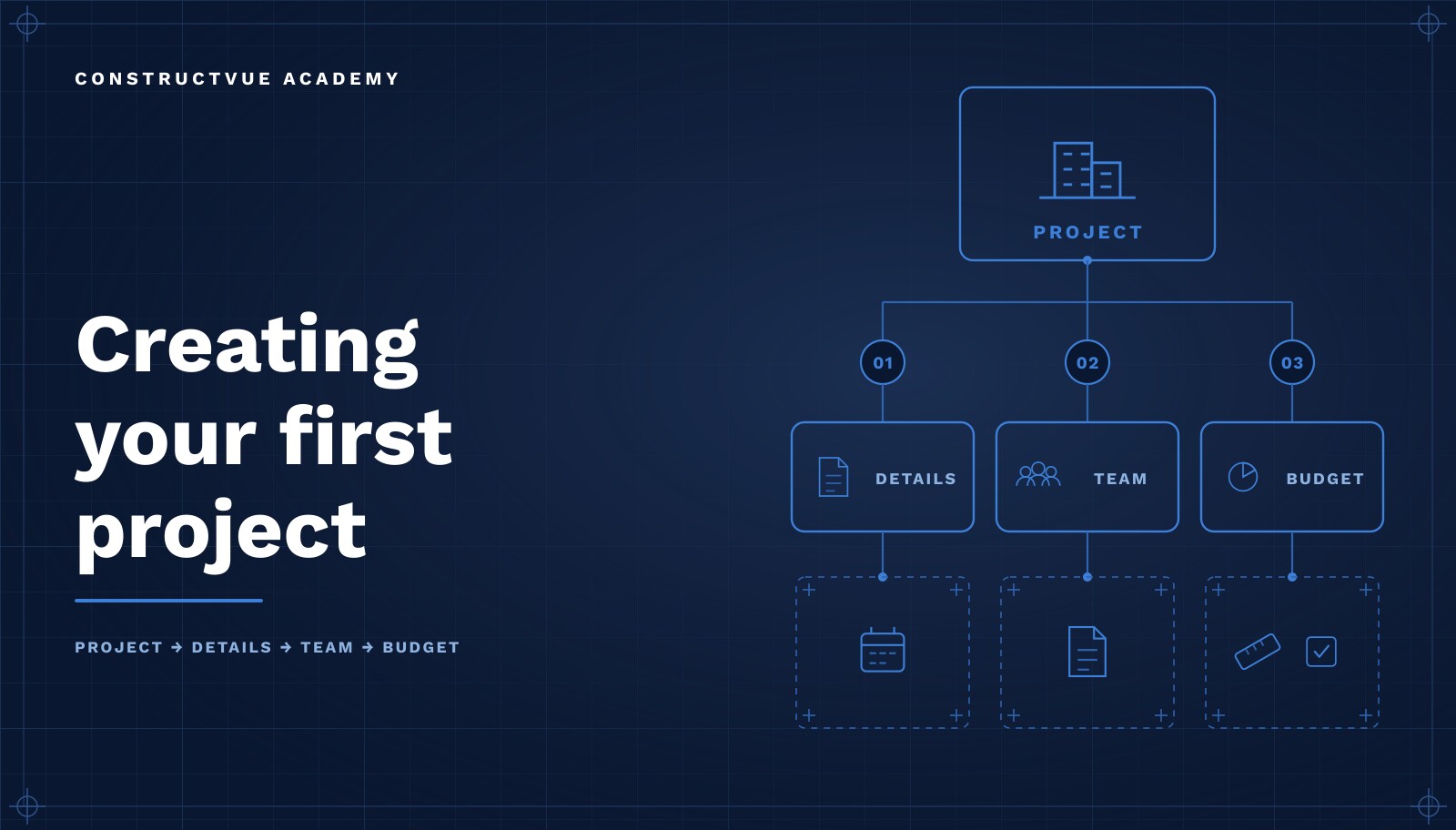
Creating a project takes a few minutes. Living with how it was created takes the rest of the job. The number you assign becomes the reference on every invoice; the template you choose decides which phases and trades exist; the team you assign decides who can commit the company; the budget you enter becomes the baseline every future variance is measured against. None of those are administrative details — they are the shape of the project record for the next eighteen months.
This lesson explains how commercial contractors set up a new construction project properly: naming and numbering standards, project templates, delivery method, the project team and their access, the budget baseline, and the governance that should be in place before the first commitment is written.
Why the first hour decides the next eighteen months
A project record is not a folder. It is the spine that commitments, change orders, daily reports, inspections, invoices and pay applications all attach to. When the spine is set up inconsistently, every downstream report inherits the inconsistency: two jobs that cannot be compared, a cost code that means one thing here and something else there, a budget whose original value nobody can reconstruct.
The practical test is simple. Six months from now, someone who was not in the room should be able to open the project and answer: what is this job, how is it delivered, who is responsible, what was it supposed to cost, and what has changed since. If setup cannot answer those five questions, setup is not finished.
Learning objectives
- Apply a project naming and numbering convention that survives reporting and invoicing.
- Choose a project template deliberately and know what it carries.
- Record the delivery method and understand what it changes downstream.
- Assemble a project team with project-scoped, least-privilege access.
- Set a budget and schedule baseline rather than a working guess.
- Turn on governance — workflows, responsibility, audit — before the first commitment.
- Know what should already be true before procurement starts.
Naming and numbering that survive reporting
Project identifiers are used far outside the software: on subcontracts, invoices, lien waivers, submittal logs, and in conversation. They need to be short, sortable, and stable for the life of the job.
- Number by year and sequence — a two-digit year plus a running number sorts chronologically forever.
- Prefix by division or region only if your company genuinely reports that way.
- Keep the number semantically empty. Clients, addresses, values and delivery methods all change; the number must not.
- Put the descriptive information in the project name, not the number.
- Decide the convention once, at the company level, and apply it to every job.
The name should read the way your team talks about the job — a recognizable building or program name, not a legal description. Consistency matters more than elegance: a portfolio where half the jobs are named for the client and half for the building cannot be searched by either.
Choosing a project template
A template is your company's default answer to "how is a job like this structured?" It typically carries phases, trade or work package breakdowns, inspection types, document structure and standard workflow rules. Applying one is the difference between setting up a project and inventing one.
What a good template carries
- Phases that match how you actually schedule and report — not a generic lifecycle.
- The trade or work package list typical for that building type.
- Inspection and quality checkpoints that are required rather than aspirational.
- Document structure so drawings, submittals and closeout material land in predictable places.
- Default approval routing consistent with company thresholds.
When to start without one
A genuinely atypical job — an unusual delivery method, a scope your company rarely performs — is a legitimate reason to start clean. What is not legitimate is skipping the template because it is faster; that decision is repaid with interest during buyout, when the work breakdown has to be reconstructed under schedule pressure.
Delivery method and what it changes
Recording delivery method at setup is not paperwork. It tells everyone downstream when scope becomes fixed, who owns design risk, and how change is priced.
CM at Risk
The contractor commits to a guaranteed maximum price while design continues. Setup should anticipate iterative buyout, contingency management, and reporting that distinguishes bought from estimated scope.
Design-build
Design and construction sit under one contract. Setup should account for design packages as work items and for change management that separates owner-driven scope change from internal design development.
Design-bid-build
Scope is fixed before award. Setup leans harder on the original budget and schedule as a baseline, because variance against a fixed scope is the primary commercial story.
The project team and project-level access
Company-wide role design — what an administrator, an executive or an accountant may do anywhere in the system — is an organization-level decision, and we cover it in the organization setup lesson. Project setup inherits that catalog; the decision here is narrower and more concrete: who is on this job, and what should this job expose to them.
- Project manager — accountable for the commercial outcome and for commitments within threshold.
- Superintendent or field lead — execution, daily reports, inspections, and field issues.
- Project engineer — RFIs, submittals, and documentation flow.
- Accounting contact — commitments, invoices, and payment status for this job.
- Executive or owner representative — visibility without transactional authority.
- External participants — subcontractors and vendors scoped to their own commitments and compliance only.
Two rules keep project access clean. First, assignment is per project: being on one job should never imply access to another. Second, access is granted for a reason and removed when the reason ends — a subcontractor's access should close with their commitment, not linger until the next audit finds it.
Budget and dates as a baseline, not a guess
The original contract value and the planned start and completion dates are the reference points every later number is judged against. Enter them at setup, mark them as the baseline, and let the system record subsequent movement as change rather than editing history.
- Original contract value — what was agreed, not what you expect to end at.
- Planned start and substantial completion — the dates the schedule is built to.
- Contingency held separately from committed budget so it never disappears silently.
- Cost structure inherited from the company standard so jobs remain comparable.
From that point forward, forecasting has something to forecast against, and owner reporting can show original, approved changes, current, and projected as four distinct numbers instead of one moving one. That is the discipline behind the cost and change management features teams rely on later in the job.
Governance from day one
Governance added mid-project is negotiated; governance present at setup is simply how the job runs. Three things belong in place before the first commitment.
Workflow rules
Approval routing and thresholds should be inherited from company standards and confirmed — not invented — at the project. A job that quietly runs different approval limits than the rest of the portfolio is a finding waiting to happen.
Responsibility
Every recurring obligation — submittal review, pay application, safety reporting, change pricing — should have a named owner on this project. "The team" is not an owner.
Audit trail
Setup decisions themselves should be recorded: who created the project, what template was applied, what the baseline was, who was assigned and when. This is exactly the connected-record principle the platform operating model is built on: one record, continuously accountable, rather than a set of documents reconciled after the fact.
A practical setup checklist
- Project number follows the company convention and is not reused.
- Project name is recognizable and consistent with the rest of the portfolio.
- Template applied deliberately, or a documented reason not to.
- Delivery method recorded.
- Planned start and completion dates entered.
- Original contract value entered and baselined; contingency held separately.
- Project team assigned with project-scoped access only.
- Approval thresholds confirmed against company standards.
- Owners named for each recurring obligation.
- Setup decisions visible in the project history.
Common project setup mistakes
Numbering invented per job
Whoever creates the project picks a format. Two years later the portfolio cannot be sorted, and invoices reference identifiers that no report recognizes.
Template skipped for speed
Saves twenty minutes at setup and costs days during buyout when the work breakdown has to be assembled retroactively.
Everyone added to every project
Project membership used as a convenience rather than an access decision. It defeats least privilege and makes the activity history much harder to read.
Budget entered as a working number
Without a baseline there is no variance — only a current figure with no provenance, which is the least useful number in construction finance.
Governance deferred to "once we get going"
Approval rules and responsibility assignments introduced mid-job are read as new bureaucracy rather than normal operating procedure, and adoption suffers.
What comes after setup
A correctly created project is the precondition for procurement: bid packages built from the work breakdown, commitments written against the baseline budget, and field execution reported against the schedule. If setup was done properly, none of those steps require re-entering information that already exists.
Frequently asked questions
What should you set up before a construction project starts?
Before the first commitment is written you need five things: a project number and name that follow your company convention, a template that carries the right phases and trades, the delivery method, the project team with the access each member actually needs, and a budget baseline with start and completion dates. Everything downstream — commitments, change orders, pay applications, reporting — inherits from those five decisions.
How should construction projects be numbered?
Use a short, sortable, meaningless-by-design code — typically a two-digit year plus a sequence, optionally prefixed by division. Avoid encoding client names, addresses or delivery methods into the number, because all of those can change while the number cannot. The number should be decided by the organization, not by whoever creates the project.
What is a construction project template?
A template is a pre-agreed starting structure: phases, trade or work packages, inspection types, document folders and workflow rules that most of your jobs share. It exists so the tenth project is set up the same way as the first, and so reporting can compare them. A template is a starting point, not a straitjacket — projects adjust from it, they do not start from nothing.
Does the delivery method change how a project is set up?
Yes. CM at Risk, design-build and design-bid-build differ in when scope is fixed, who carries design risk, and how buyout and change management behave. Recording the delivery method on the project record makes those differences explicit and lets reporting group like jobs with like jobs rather than averaging them together.
Who should be on a construction project team?
At minimum a project manager who is accountable for the commercial outcome, a superintendent or field lead responsible for execution, a project engineer handling RFIs, submittals and documentation, and accounting for commitments and payment. Executives and owner representatives are usually visibility-only. Assign people to the project with the narrowest access that lets them do their job.
Why set a budget baseline at setup instead of later?
A baseline is the reference point that makes variance meaningful. If the original budget is edited as the job progresses, you can still see today's number but you can no longer prove what changed, when, or why. Setting the baseline at creation and recording every later movement as a change keeps forecasting and owner reporting defensible.
Related Academy lessons
For the wider operating model this project record supports, see the platform overview, how general contractors use ConstructVue, or return to the Academy hub.
Lesson chapters
- 0:04Welcome
- 0:22Creating the project
- 1:01Assigning users and roles
- 1:41Configuring project workflows
- 2:11Next steps