
ConstructVue Academy · Lesson 6
How construction teams run project controls and financial management
Where budget, commitments, change and forecast meet — a cost-code budget every line owns, commitments created from executed contracts, change priced and approved before it moves a number, and a forecast that shows how the outlook moved over time.
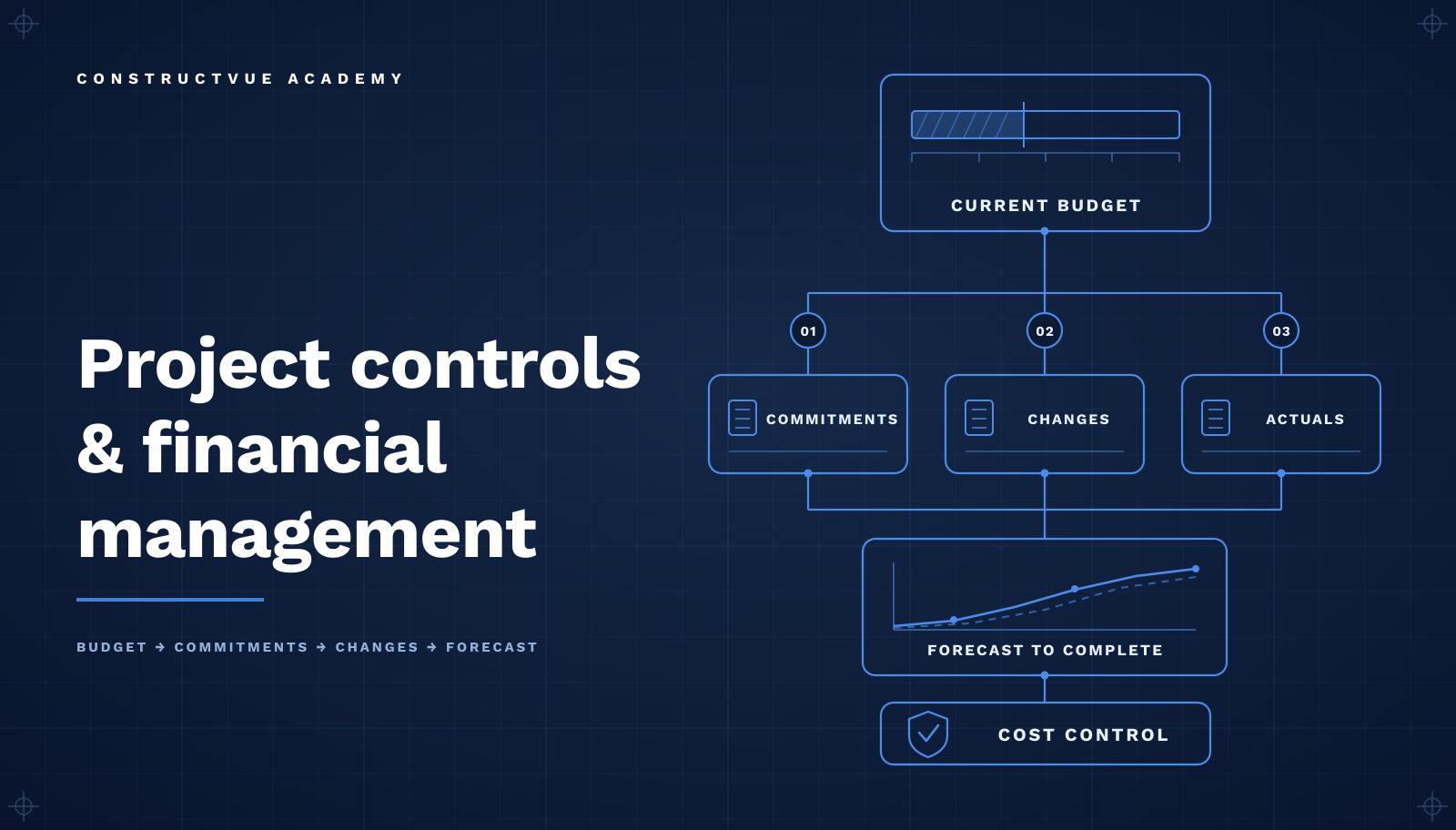
Project controls is the part of a commercial job where intent stops mattering and arithmetic takes over. The budget was a decision made before the work started. The commitments are what the project actually bought. The change log is everything the first two did not anticipate. Controls is the discipline of keeping those three readable against each other while there is still time to act on what they say.
This lesson covers how a cost-controlled project is run — how the budget is structured, where commitments come from, how change is captured and approved, how forecasting produces an estimate at completion, and why every figure needs a trail back to the event that created it. It assumes procurement is already running; if it is not, start with the procurement lesson.
Learning objectives
- Structure a budget by cost code, with one owner per line and a clear link to the scope it funds.
- Distinguish budget, committed cost, actual cost and forecast, and know which question each one answers.
- Create commitments from executed contracts rather than as separate manual entries.
- Capture change as an event, carry it as pending while it is priced, and approve it into a change order.
- Produce an estimate at completion on a rhythm, and read the movement between periods rather than a single snapshot.
- Trace every figure in a cost report back to the record and the approval that produced it.
The budget baseline
A budget is only useful if it is the structure everything downstream can be reconciled against. That means cost codes that match how the work will be bought, not a chart of accounts inherited from finance and never revisited.
One owner per line
Every budget line should have a named person accountable for it. Lines nobody owns are the ones that overrun quietly, because nobody is reading them between reporting cycles.
The baseline is not the current budget
Keep the original baseline separate from the current budget. Approved change moves the current budget; the baseline stays fixed. Without that separation you lose the ability to say how far the job has moved from what was agreed, which is the first thing an owner or a lender will ask.
Commitments
A commitment is contractual obligation, not intent. It should be created by an executed contract — the award event, the subcontract, the purchase order — and carry the schedule of values the vendor will bill against.
- Commitments come from awards, so the value in the cost report is the value that was actually contracted.
- Each commitment maps to the budget line or lines it consumes, so coverage and exposure are visible.
- Approved change orders adjust the commitment, not a side note attached to it.
- Uncommitted budget is a real number: it is the work still exposed to the market.
The most common failure here is a project that is fully bought but reports almost nothing committed, because the commitments were never created from the contracts. The cost report is then a forecast of a job nobody is running.
Change management
Change is the normal condition of construction. What separates a controlled job from an uncontrolled one is not the amount of change but whether it is visible before it is irreversible.
Capture as an event
A change starts as an event: something happened, and it may cost money. Recording it at that point costs nothing and preserves the date, the cause and the originating record.
Pending is a state, not a delay
Between identification and approval, a change is pending — priced, under review, not yet in the budget. Pending change belongs in the forecast as exposure. Projects that hide it report a stable budget and then move sharply, which is the pattern that destroys credibility with owners.
Approval moves the number
Only an approved change order should adjust the current budget and the affected commitment, and it should do so from the approval itself rather than a parallel entry made later by hand.
Forecasting to completion
Forecasting answers a different question from cost reporting. Cost reporting says what has happened; the forecast says where the job lands. An estimate at completion combines actual cost to date, remaining commitment, and a considered view of the cost still to come — including pending change that is likely to be approved.
- Forecast on a rhythm — monthly at minimum — so the movement between periods is readable.
- Record the basis of each forecast, so a later reader knows what was assumed rather than guessing.
- Keep forecast history: the trend is the signal, a single number is not.
- Compare estimate at completion against the baseline, not only against the current budget.
A forecast produced once, at the point the project is already in trouble, is a post-mortem. The value comes from the series.
Traceability and the activity trail
Every figure in a cost report is the sum of events: an award, an invoice, an approved change, a budget transfer. When those events are recorded on the same record the number is read from, the report can be interrogated rather than defended.
This is the same single-event principle described in how it works. It matters most in the moments cost control exists for: the first pay application dispute, the owner asking why the forecast moved, the change order somebody says was never approved.
Common project controls mistakes
Reporting committed cost as spend
Committed and actual are different obligations at different stages. Reporting them as one number overstates progress early and understates exposure late.
Change tracked in a spreadsheet beside the budget
A parallel change log diverges from the budget within weeks, and the reconciliation becomes somebody's monthly job rather than a property of the record.
Forecasting only when asked
A forecast produced for a meeting is a defensive document. One produced on a rhythm is a management tool.
Budgets that do not match how work is bought
If the cost code structure and the contracting structure disagree, every commitment needs a translation step and every reconciliation is manual.
Where this fits
Project controls sits downstream of procurement and upstream of executive reporting. The commitments it reads come from award; the forecast it produces is what portfolio reporting aggregates. The next lesson in the series moves to that level: executive intelligence and portfolio visibility.
Frequently asked questions
What are project controls in commercial construction?
Project controls are the disciplines that keep cost, scope, change and schedule reconciled against a baseline while the work is still in progress. In practice that means a budget structured by cost code, commitments that come from executed contracts, change events priced and approved before they move a number, and a forecast that is updated on a rhythm rather than at the end.
What is the difference between committed cost and actual cost?
Committed cost is money the project is contractually obligated to spend — the value of executed subcontracts and purchase orders, plus approved change orders. Actual cost is what has been invoiced and recognized against those commitments. A project can be almost fully committed while very little has been billed; treating the two as the same number is one of the most common ways a cost report misleads.
How should a construction budget be structured?
By cost code, with one owner per line and a clear link to the scope the line pays for. The structure should match how work will actually be bought, so a bid package, a commitment and a budget line can be reconciled without translation. A budget that only exists at the summary level cannot answer where the money went, which is the only question that matters in month four.
When should a change become a change order?
A change should be captured as an event the moment it is identified, carried as pending while it is priced and reviewed, and converted to a change order only when it is approved. Pending change is not noise — it is the part of the forecast that has not landed yet. Skipping the pending stage means the budget looks stable right up until it does not.
What is estimate at completion and why does it matter?
Estimate at completion is the projected final cost of the work: what has been spent, plus what remains committed, plus a considered view of the cost still to come. It matters because the budget is a decision made before the job started and the estimate at completion is what the job is now telling you. The gap between them, tracked over time, is the earliest reliable signal a project is drifting.
Why does every financial figure need an audit trail?
Because a number without a source cannot be defended and will eventually be argued about. When a budget movement, a commitment value or an approved change can each be traced to the record and the approval that created it, cost reporting stops being a monthly reconstruction exercise and becomes a read of the underlying events.
Related Academy lessons
For the wider system these financial records feed, see the platform overview and how general contractors use ConstructVue, or return to the Academy hub.